Medicare

Medicare is a federal health insurance program in the United States that primarily provides coverage for qualifying people age 65 and older, as well as certain younger individuals with disabilities or end stage renal disease.


While Medicare is an important program providing healthcare support, individuals often need to make personal decisions about whether (and in which Medicare Parts) to enroll, when to enroll, and whether to add supplemental coverage to help pay out-of-pocket expenses.

Medicare is made up of different parts—Part A (hospital insurance), Part B (medical insurance), Part C (Medicare Advantage plans offered through private insurers), and Part D (prescription drug coverage)—each covering different types of care.


Medicare helps pay for a wide range of healthcare services, including hospital stays, doctor visits, outpatient care, and prescription drugs, although it does not cover all costs.


Important: Microsoft cannot advise you on whether, when, or in which Parts to enroll in Medicare. This information is educational only. For personalized guidance, you may wish to consult official Medicare or Social Security sources, or a licensed benefits advisor.


Medicare is a federal health insurance program primarily for qualifying individuals who:


  • Are age 65 or older
  • Are under age 65 but with qualifying disabilities
  • Have End‑Stage Renal Disease (ESRD)


Medicare has different parts that cover different services:


  • Part A: Hospital coverage (inpatient, some skilled nursing, etc.).
    • Usually premium free if you or your spouse paid Medicare taxes for at least 10 years
    • Many employees choose to enroll in Part A when first eligible, even while working (understanding this will prevent you from being eligible to contribute to an HSA, and note that in some cases Part A coverage can be retroactive)
  • Part B: Medical coverage (doctor visits, outpatient care, preventive services, etc.).
    • Requires a monthly premium
    • Late enrollment (after initial eligibility and enrollment window) can result in significant lifetime financial penalties
  • Part D: Prescription drug coverage
    • Purchased through private insurers
    • Late enrollment can also result in a penalty


  • Medicare Advantage (Part C): A private plan alternative to Original Medicare that combines Medicare Parts A and B (and usually Part D). Most Medicare Advantage plans include extra benefits like dental, vision, or hearing coverage, and may require of use in-network providers and advance approval for some services.
  • Medigap (Medicare Supplement): Private, optional, additional coverage that helps pay some of the out‑of‑pocket costs not covered by Original Medicare (Parts A and B), such as deductibles, copayments, and coinsurance. You must be enrolled in Medicare Part A and Part B to buy a Medigap plan.

Most people qualify for Medicare when they turn 65, but individuals under 65 may also be eligible if they have a qualifying disability or end-stage renal disease (ESRD). Part A is free if you or your spouse paid into Social Security for at least 10 years through employment.


Some people are automatically enrolled in Part A if they are already receiving Social Security benefits, while others must sign up during their designated enrollment period.


Learn more at ssa.gov.


When should I enroll in Medicare?


This is a personal decision based upon age, disability status, and other individual factors. Microsoft can’t advise you on your personal Medicare decisions, or provide legal, tax, or Medicare enrollment advice. But we do encourage you to start researching your healthcare options early, particularly if you’ve considered or made the decision to retire or otherwise leave Microsoft.


Enrollment Periods


Initial Enrollment Period


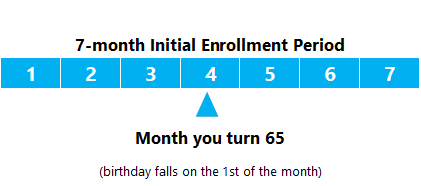
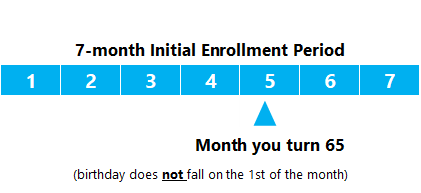
Your Initial Enrollment Period (IEP) is unique to your birthday. You have a 7-month window to sign up for Medicare, which typically begins 3 months before the month you turn 65 and ends 3 months after the month you turn 65 (or if your birthday is on the first of the month, begins 4 months before and ends 2 months after the month you turn 65). If you sign up before your birthday month, your coverage will start on the first day of the month you turn 65. If you sign up during your birthday month or thereafter, your coverage will start on the first day of the month after you sign up.


General Enrollment Period


If you don’t enroll during your IEP (or a Special Enrollment Period), you can enroll in Part A, Part B, or both during the General Enrollment Period (GEP), which runs from January through March each year. Your coverage will start the first day of the month after you sign up, and you can be charged a financial penalty for late enrollment, which will be added to all of your Part B premiums for life. You may also choose to join a Medicare Advantage plan (Part C), a Medicare Supplement (Medigap) plan, and/or a prescription drug plan (Part D) during specified enrollment windows.


Special Enrollment Period


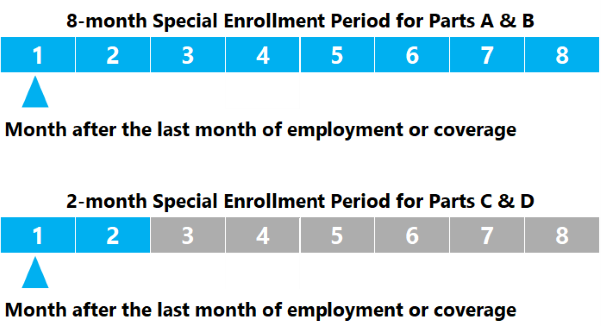
If you don’t sign up for Part B when you’re first eligible because you (or your spouse) have coverage through current employment, you may qualify for a Special Enrollment Period (SEP) when your (or your spouse’s) employment or coverage ends, and avoid late enrollment financial penalties. You can sign up for Part B while you’re still enrolled in that other coverage, or during an 8-month window that begins the month after the employment or other coverage ends (whichever happens first). Your coverage generally starts the first day after the month you sign up, although special timing rules can apply in some cases. You may also qualify for enrollment periods to join a Medicare Advantage plan (Part C), Medicare Supplement (Medigap) plan, and/or a prescription drug plan (Part D). For Medicare Advantage (Part C) and prescription drug (Part D) plans, you generally have up to two full months after the end of your coverage to enroll, if you are eligible. Medicare Supplement (Medigap) plans follow different rules and generally don’t have the same special enrollment period timelines.

 

Where do I start?


Microsoft can’t advise you on your personal healthcare decisions, but there are resources that can help you understand when to enroll, how Medicare works with employer coverage or COBRA, and what penalties may apply. The free resources below are examples only and other educational resources may also be available. Microsoft does not sponsor or endorse any of these (or other) Medicare sources, and is providing the examples below for your convenience.


  • The entities listed below provide individualized guidance to help you understand healthcare options after employment. They can help you explore alternatives such as exchange plans, and understand how Medicare fits into your situation, COBRA coordination, and available coverage paths based on your circumstances. They can also address options if your dependent becomes eligible for Medicare on a different timeline than you.
    • Via Benefits:  Via Benefits or 1-855-803-2540
    • State Health Insurance Assistance Program: SHIP or 1-877-839-2675
  • Medicare.gov (Welcome to Medicare | Medicare): the official Medicare website with explanations, tools, and FAQs related to Medicare enrollment, Special Enrollment Periods, and COBRA coordination
  • Enroll in Medicare online at ssa.gov or visit a Social Security office near you and enroll in person. Call for an appointment and a list of documents you’ll need to bring with you.
  • If you previously delayed enrolling in Medicare due to your active employment with Microsoft, you may need additional documentation to enroll in Medicare in order to avoid financial penalties and a potential loss of guaranteed-issue Medicare products (subject to state law) and a Special Enrollment window:
  • CMS-L564 Form. This form provides proof of employer health coverage so you can enroll in Medicare Part B during a Special Enrollment Period in connection with your termination of employment without penalties.

To request Microsoft completion of the employer portion of your CMS-L564 Form, contact benefits@microsoft.com with Section A completed by you. You can find the form at www.cms.gov/medicare/cms-forms.

  • Notice of Creditable Coverage. The purpose of the notice is to tell Medicare‑eligible individuals whether their employer’s prescription drug coverage is “creditable.” “Creditable” means the employer’s drug coverage is expected to pay, on average, at least as much as the standard Medicare Part D prescription drug benefit. You can download this notice from the Microsoft benefits portal at: Plan Documents & Tax Information. 
  • Microsoft COBRA Service Center. After your last day with Microsoft, you may contact the Microsoft COBRA Service Center to enroll at cobra.me.microsoft.com. The company key is ‘microsoft.’ You can also contact the COBRA Service Center at 833-253-4929 or email Microsoft@businessolver.com to enroll or ask questions.


Information needed to make a decision


Important information to consider when researching your healthcare options


Below is a list of details that may be helpful to share when speaking with someone about your healthcare options when leaving Microsoft, including COBRA and Medicare. Whether you are gathering information, asking questions, or exploring options, explaining your unique situation will be helpful to the person helping you and can better ensure the information you receive reflects your specific timing, coverage needs, and family situation.


  • My last day of active Microsoft employee healthcare coverage will be <your last day as a Microsoft employee>.
  • I can enroll in COBRA healthcare continuation coverage offered by my employer for up to 18 months. COBRA coverage will begin <your last day as a Microsoft employee + 1 day> and will end the earlier of (1) 18 months or (2) when I become enrolled in other coverage including Medicare.
  • I turned or will turn 65 (or otherwise become eligible for Medicare) on <mm/dd/yyyy>.
  • My spouse turned or will turn 65 (or otherwise become eligible for Medicare) on <mm/dd/yyyy>.


Questions to consider asking:


I want to make sure I do not incur any financial penalties related to Medicare enrollment or lose my ability to purchase guaranteed-issue Medicare products (like Medigap).


  • What actions do I (we) need to take related to Medicare and by what dates?
  • Do I need to enroll now or delay enrollment?
  • How does my company’s COBRA coverage work with Medicare?